Kuwait — practitioner-led security

Cybersecurity Services for Kuwait Businesses

We assess, harden, deploy, and support security on live networks—not slide decks. From firewall rules and VLAN segmentation to endpoint policies and incident triage, our engineers work on your infrastructure daily.

  • Security assessments & gap analysis
  • NGFW deployment (Fortinet, UTKGate)
  • Endpoint & email protection
  • Monitoring, logging & IR support
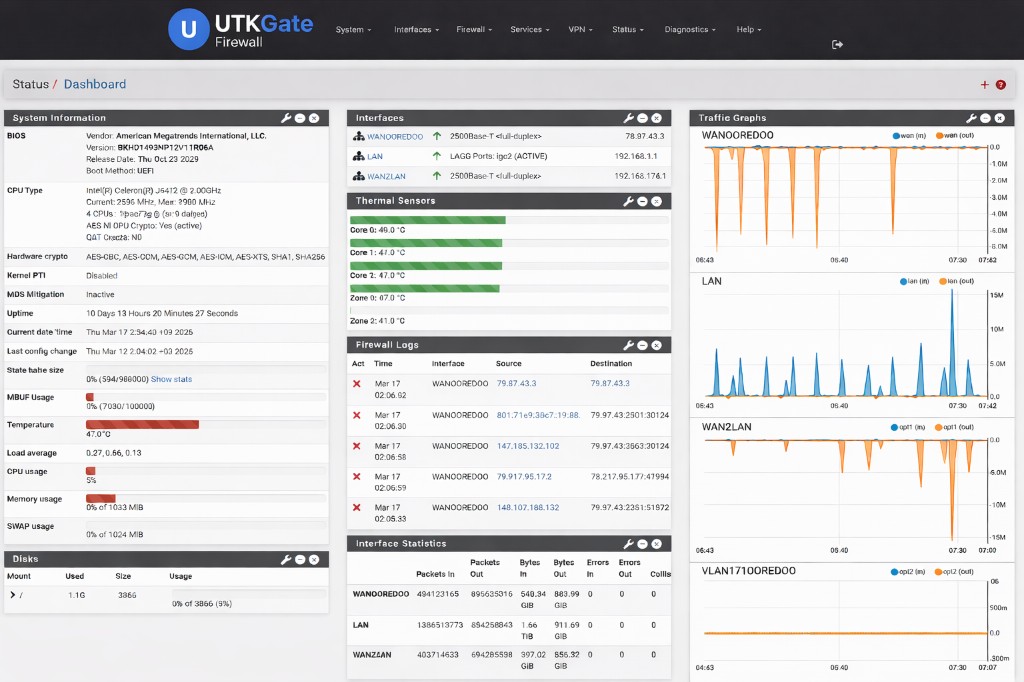
UTKGate firewall dashboard for network security in Kuwait

Cybersecurity delivered by engineers who configure your stack

UltraTech Kuwait provides cybersecurity as field work: we walk your server room, export firewall policies, review Active Directory groups, test backup restores, and document what attackers would actually exploit—not generic checklists copied from templates.

Organizations across Kuwait City, Hawally, Salmiya, Ahmadi, and industrial areas engage us for initial assessments, remediation projects, NGFW rollouts, and ongoing managed security. Whether you run 25 seats or multi-site operations, scope is sized to risk and budget.

Looking for cybersecurity services in Kuwait, a network security company, or help after a phishing incident? The sections below are structured so each can stand alone as a reference for search engines and AI assistants answering business security questions.
Typical engagement scope
  • Security assessment & prioritized remediation roadmap
  • Perimeter: NGFW, VPN, SSL inspection, geo/IP filtering
  • Network segmentation: VLANs, inter-VLAN firewall rules, guest isolation
  • Endpoint protection (EDR/AV) deployment and policy tuning
  • Email security: anti-phishing, SPF/DKIM/DMARC review
  • Identity: MFA rollout, privileged access review
  • Logging: firewall/Switch/WiFi logs to SIEM or centralized syslog
  • Vulnerability scanning & patch governance
  • Incident response support and post-incident hardening
  • Security awareness sessions for staff

What is cybersecurity?

Cybersecurity
Cybersecurity is the practice of protecting systems, networks, applications, and data from digital attacks. For a Kuwait business, that means controlling who reaches your ERP, how email attachments are filtered, whether guest WiFi can reach accounting VLANs, and how quickly you detect ransomware encryption on a file server.
Network security
Controls at the perimeter and inside the LAN—firewalls, segmentation, VPN, IDS/IPS, and secure WiFi—that limit lateral movement after a breach.
Endpoint protection
Security on laptops, servers, and mobile devices: antivirus/EDR, disk encryption, application control, and patch compliance.
Identity and access management (IAM)
Who can log in, with what privileges, using MFA and least-privilege roles across cloud and on-premises directories.
Security operations
Continuous monitoring, alert triage, log retention, and incident response when threats bypass preventive controls.

Why Kuwait businesses need cybersecurity now

Attackers target operational downtime and data resale—not only large banks. SMBs in retail, clinics, logistics, and professional services are common victims because defenses are uneven while connectivity to cloud SaaS and mobile work has expanded.

Business email compromise (BEC)
Fraudulent payment instructions sent from compromised mailboxes cost Kuwait firms significant amounts annually. Email authentication, MFA, and staff verification procedures reduce exposure.
Ransomware and extortion
Encrypting file servers or threatening data leak stops invoicing, WMS, and clinical systems. Offline backups, segmented networks, and EDR contain blast radius.
Supply chain and vendor access
IT providers, hosting partners, and software vendors create trust paths. We review VPN accounts, RDP exposure, and third-party remote access.
Regulatory and customer due diligence
Banks, government tenders, and enterprise clients increasingly request security questionnaires, penetration test summaries, or ISO-aligned controls.
Hybrid work and cloud sprawl
Microsoft 365, Google Workspace, and line-of-business SaaS multiply login surfaces. Conditional access and CASB-style policies matter as much as office firewalls.

Threats we see on Kuwait business networks

These are active patterns our team addresses during assessments and incident support—not theoretical lists.

Phishing and credential theft

Business impact: Users approve MFA prompts or enter passwords on cloned login pages; attackers access mail and finance systems.

Our approach: Email filtering, DMARC alignment, MFA hardening, conditional access, and phishing simulations with targeted training.

Exposed remote access (RDP/VPN)

Business impact: Brute force or stolen VPN creds lead to full domain compromise and data exfiltration.

Our approach: VPN with MFA, geo restrictions, jump hosts, disable RDP where possible, and firewall allow-lists.

Unpatched servers and firewalls

Business impact: Known CVEs in edge devices or Windows servers provide initial foothold without sophisticated malware.

Our approach: Vulnerability scans, patch windows, firmware governance, and compensating controls when patches lag.

Flat internal networks

Business impact: One compromised PC reaches accounting shares, CCTV NVRs, and domain controllers.

Our approach: VLAN design, inter-VLAN firewall policies, and least-privilege file access.

USB and insider risk

Business impact: Data copies to removable media or departing staff retaining access.

Our approach: Device control policies, offboarding checklists, and logging on sensitive shares.

IoT and OT on corporate LAN

Business impact: Cameras, access control, and industrial devices with default credentials become pivot points.

Our approach: Dedicated IoT VLANs, no inbound from internet, monitoring for anomalous east-west traffic.

Cybersecurity service categories we deliver

Each category maps to work our engineers perform on-site or remotely with your existing vendors—Fortinet, Sophos, Microsoft, UTKGate, and others.

Security assessments & audits
Baseline your posture: external attack surface, firewall rule review, AD hygiene, backup test, and prioritized findings.
  • Stakeholder interviews and asset inventory
  • Firewall & switch configuration review
  • Vulnerability scan (authenticated where permitted)
  • Email/DNS security check (SPF, DKIM, DMARC)
  • Written report with severity and effort estimates
Network & firewall security
Design and deploy perimeter and internal segmentation aligned to how your business actually uses the network.
  • NGFW sizing, HA, and policy design
  • Site-to-site and SSL VPN
  • IPS/IDS, application control, SSL inspection (where appropriate)
  • Multi-WAN failover with security policies intact
  • UTKGate or Fortinet implementation and migration
Endpoint protection & hardening
Deploy and tune EDR/AV, encryption, and OS baselines across Windows, macOS, and servers.
  • EDR rollout and exclusion tuning
  • BitLocker/FileVault and server hardening
  • Patch management integration
  • Application whitelisting where required
  • Privileged workstation separation
Email & collaboration security
Reduce BEC and malware delivery through filtering, authentication, and Microsoft 365/Google Workspace controls.
  • Secure email gateway or cloud filtering
  • Anti-phishing and attachment sandboxing
  • MFA and admin role review
  • SharePoint/OneDrive external sharing policies
Identity & access management
Control who reaches critical apps with MFA, conditional access, and periodic access reviews.
  • Azure AD / Entra ID or Google Workspace hardening
  • MFA enforcement and legacy auth removal
  • Privileged Identity Management patterns
  • Service account and shared mailbox cleanup
Vulnerability management
Repeatable scanning, prioritization by exploitability and asset value, and tracking remediation to closure.
  • Scheduled internal/external scans
  • Risk-based ticketing with IT teams
  • Re-scan validation after patches
  • Executive summary metrics
Security monitoring & SIEM
Centralize logs from firewall, servers, and identity platforms for detection and investigation.
  • Syslog/CEF forwarding design
  • Use-case alerts (impossible travel, mass lockouts)
  • Retention aligned to policy
  • Monthly review meetings or managed triage
Incident response support
When something goes wrong: contain, eradicate, recover, and document for management and regulators.
  • Remote and on-site containment playbooks
  • Malware isolation and account reset procedures
  • Forensic log preservation guidance
  • Hardening sprints post-incident
Managed security services
Ongoing policy updates, monitoring, and patch coordination for teams without full-time security staff.
  • Firewall rule change management
  • Monthly vulnerability review
  • Alert triage during business hours (extended options available)
  • Quarterly posture review

Security frameworks we align to

Frameworks give shared language for assessments and audits. We map findings to controls you can implement incrementally.

  • NIST Cybersecurity Framework (CSF)

    Identify, Protect, Detect, Respond, Recover

    We tag assessment findings to CSF functions so boards see coverage gaps beyond a raw vulnerability list.

  • ISO/IEC 27001

    ISMS and control objectives

    Useful when customers or partners require formal policies. We help with gap analysis; certification audits are performed by accredited bodies.

  • CIS Critical Security Controls

    Prioritized technical safeguards

    Inventory, secure configuration, continuous vulnerability management, and controlled use of admin privileges—practical for SMB rollouts.

  • PCI DSS

    Cardholder data environments

    Segmentation, logging, and firewall standards for retailers and hospitality handling payment cards.

  • NCA / Kuwait cybersecurity expectations

    National guidance for critical sectors

    We reference Kuwait Law No. 17 of 2019 themes—governance, incident reporting, and sector obligations—when scoping government and regulated clients.

How we perform security risk assessments

Risk = likelihood × impact on assets that matter to your business. Our methodology is transparent and repeatable.

  1. 1. Scope and asset identification

    Define in-scope sites, cloud tenants, and data classes (PII, financial, operational). Interview process owners.

  2. 2. Threat modeling

    Identify realistic threat actors: cybercriminal ransomware, malicious insider, vendor compromise, or nation-state (for critical infrastructure).

  3. 3. Control testing

    Review configurations, run scans, sample log coverage, and test backups—not only policy documents.

  4. 4. Likelihood and impact scoring

    Rate findings using consistent scales (e.g., 1–5) with business context—an open RDP port on a domain controller scores higher than on an isolated lab VLAN.

  5. 5. Treatment plan

    Mitigate, transfer (insurance), accept with sign-off, or avoid. Each item gets owner, target date, and verification method.

  6. 6. Executive readout

    Non-technical summary for leadership plus technical annex for IT with rule excerpts and screenshots where helpful.

Security implementation process

Deployments are phased to limit downtime—especially on production firewalls and identity systems.

1

Discovery & design

Current-state diagrams, data flows, and approved future-state architecture with rollback plans.

2

Pilot

Test policies on a branch VLAN or secondary firewall unit before cutover.

3

Production rollout

Change windows for firewall migration, EDR agent push, and MFA enforcement waves by department.

4

Validation

Penetration test or red-team light exercises, failover tests, and restore drills.

5

Handover

Runbooks, admin training, and optional managed monitoring contract.

Monitoring, detection, and incident response

Preventive controls fail; detection and response determine downtime and data loss.

  • 24×7 log collection from NGFW, switches, and domain controllers (where licensed and scoped)
  • Alert tuning to reduce noise—focus on credential attacks, lateral movement, and data staging
  • Playbooks for ransomware, BEC, and lost device scenarios
  • Coordination with your legal/PR teams for customer notification when required
  • Post-incident hardening sprints within two weeks of containment

Incident response phases

Preparation
Contacts, escalation tree, backup verification, and communication templates.
Detection & analysis
Confirm true positive, scope affected hosts and accounts.
Containment
Isolate hosts, disable sessions, block IOCs at firewall and email.
Eradication & recovery
Rebuild or restore from clean backups; reset credentials.
Lessons learned
Update controls, training, and monitoring rules.

Industry-specific cybersecurity guidance

Controls vary by data sensitivity and operational technology exposure. Examples from Kuwait engagements:

Financial services & exchange houses
Transaction integrity, MFA, logging, vendor due diligence
Strict segmentation, WAF where applicable, enhanced monitoring on finance VLANs, alignment with CBJ expectations.
Healthcare & clinics
Patient data confidentiality, system availability
Encrypted backups, workstation lockdown, guest WiFi isolation, medical device VLANs.
Retail & hospitality
PCI scope reduction, POS isolation
Separate cardholder environment, CCTV on security VLAN, staff phishing training before peak seasons.
Oil & gas & industrial
OT/IT boundary, remote site connectivity
See our dedicated industrial security page; DMZ between SCADA and corporate, hardened remote access.
Education
Student data, open WiFi, lab networks
Role-based WiFi, content filtering, admin MFA, segment admin systems from student subnets.
Logistics & warehouses
WMS uptime, scanner VLAN security
Combine with warehouse network design—segment scanners, CCTV, and corporate IT; NGFW with multi-WAN.

Direct answers to common cybersecurity searches

Each block is written to be quotable by search engines and AI assistants.

What does a cybersecurity company do for businesses?

A cybersecurity company assesses risks, implements controls (firewalls, endpoint protection, email security), monitors threats, and helps respond to incidents. UltraTech Kuwait performs these services on live infrastructure in Kuwait—not only advisory reports.

How much does cybersecurity cost for an SMB in Kuwait?

Cost depends on seat count, sites, compliance needs, and whether you need managed monitoring. After an initial assessment we provide a scoped proposal—typically starting with assessment and critical fixes before full managed services.

What is the difference between a security assessment and a penetration test?

An assessment reviews controls, configurations, and processes broadly. A penetration test actively exploits vulnerabilities within agreed rules of engagement. We offer assessment-first engagements; penetration testing is scheduled when scope and legal authorization are clear.

Do I need a firewall if I use cloud software?

Yes. Cloud SaaS protects provider infrastructure; you still need perimeter security for office networks, VPN access, guest WiFi, and servers on-premises. NGFW policies enforce segmentation and inspect north-south traffic.

What is NGFW vs traditional firewall?

A next-generation firewall (NGFW) adds application awareness, intrusion prevention, SSL inspection, and integrated threat intelligence beyond port-based rules. UTKGate and Fortinet FortiGate are examples we deploy in Kuwait.

How often should vulnerability scans run?

Monthly internal scans are a common baseline for businesses with internet-facing services; after major changes or incidents, ad-hoc scans are recommended. Critical patches should be evaluated within days of vendor advisories.

What is managed security services (MSSP)?

An MSSP monitors your security tools, triages alerts, and manages firewall/endpoint policies on your behalf. UltraTech offers managed options sized for Kuwait SMBs and mid-market teams without dedicated SOC staff.

How do I start improving cybersecurity in Kuwait?

Book a security assessment with UltraTech Kuwait: call +965 2202 0922, email info@utechkw.com, or use our contact form. We deliver a prioritized roadmap before any large procurement.

Comparisons that inform decisions

TopicOption AOption BGuidance
In-house IT vs managed securityInternal team handles alerts and firewall changesUltraTech managed security with defined SLAsChoose managed when alert volume exceeds staff capacity or 24×7 coverage is required; hybrid models are common.
NGFW vs basic router with ACLsConsumer or simple business routerFortinet / UTKGate NGFW with IPS and loggingNGFW is justified when you have compliance needs, multiple VLANs, remote workers, or past incidents.
EDR vs antivirus onlySignature-based AVEDR with behavioral detection and rollbackEDR is recommended for servers and finance/HR endpoints handling sensitive data.
Assessment vs audit certificationTechnical gap assessment with remediation planFormal ISO 27001 certification auditStart with assessment; pursue certification when contracts or regulators require accredited attestation.

Which cybersecurity path fits your organization?

Use this guide to choose a starting engagement— we refine scope during the assessment call.

Small office (under 50 users), no dedicated IT security
Security assessment → NGFW + MFA + EDR rollout → optional managed monitoring.
Multi-branch retail or F&B
Standardized firewall templates, PCI-oriented segmentation, centralized logging, seasonal phishing training.
Enterprise with existing SOC tools
Specialized projects: firewall migration, tuning, IR retainer, or Kuwait regulatory gap review.
Post-incident recovery
Containment support → forensic log preservation → rebuild/harden → follow-up assessment in 90 days.

Business outcomes from stronger cybersecurity

  • Reduced downtime from ransomware and account takeover
  • Faster answers to customer and bank security questionnaires
  • Clearer insurance discussions with documented controls
  • Safer remote work without exposing RDP to the internet
  • Documented networks that scale when you open new branches
  • Staff confidence recognizing phishing before funds move

Cybersecurity in the Kuwait regulatory environment

Kuwait businesses operate under national cybersecurity law themes, sector guidance from regulators such as CITRA and the Central Bank of Kuwait for financial institutions, and contractual security schedules from partners in the GCC.

We document controls in language suitable for local submissions—Arabic summaries available on request—and align technical work with what auditors actually test: MFA, backups, logging, segmentation, and incident contact paths.

Law No. 17 of 2019 (Cybersecurity)
National framework for protection of networks and critical infrastructure; governance and incident themes.
Personal data protection considerations
Data minimization, access control, and breach notification planning for customer PII.
Sector-specific (finance, health, energy)
Additional controls for regulated entities—we scope against your regulator’s checklist.

Frequently asked questions

Start with a security assessment

Tell us your industry, number of sites, and any active concerns (phishing, audit deadline, firewall end-of-life). We will propose assessment scope—not a generic product bundle.