Client Overview
A homeowner in the Daher area of Kuwait contacted UltraTech after experiencing persistent network problems throughout his property.
The property consisted of:
Main house connected to a 5G Internet service
Download Speed: 500–600 Mbps
Upload Speed: 30–40 Mbps
Separate Diwaniya building connected to a 100 Mbps QualityNet (STC by Solutions) fiber connection
The client's primary objective was to unify both buildings under a single, reliable network so that the high-quality fiber connection could be used throughout the property while eliminating the ongoing connectivity issues.
Challenges Reported by the Client
The customer had been experiencing network issues for an extended period, including:
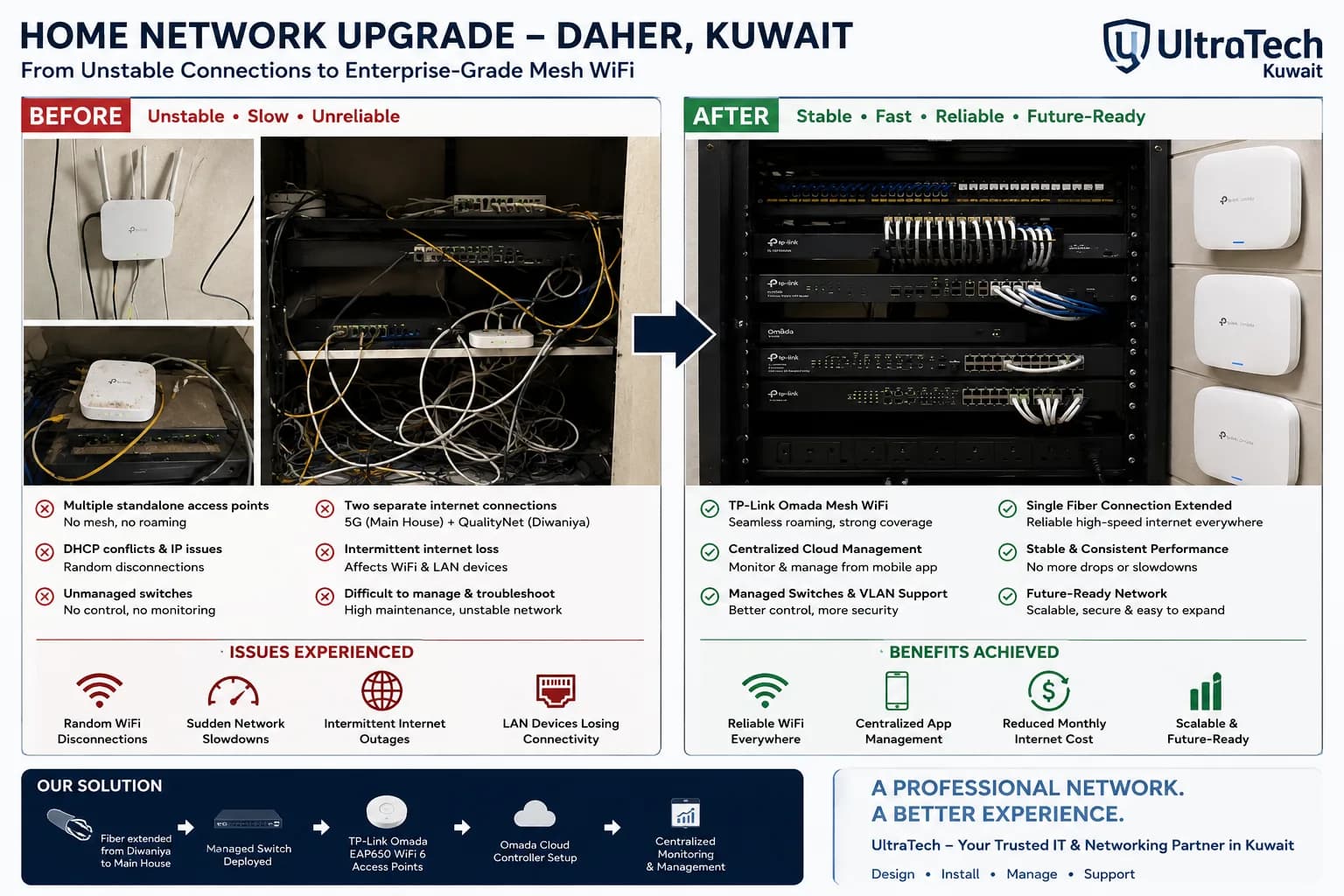
Random Wi-Fi disconnections
Sudden network slowdowns affecting all users
Intermittent internet outages across the entire property
Wired (LAN) devices losing internet access along with wireless devices
Poor roaming between access points
Unstable performance despite having multiple Wi-Fi access points installed
These issues significantly affected daily internet usage, smart home devices, streaming services, and general productivity.
Site Survey & Network Assessment
Our engineers performed a complete on-site network survey to identify the root cause.
Existing Network Infrastructure
The inspection revealed:
Multiple TP-Link TL-WA1201 standalone wireless access points
Approximately 7–8 Wi-Fi access points throughout the property
Several unmanaged budget TP-Link switches
Multiple independent wireless access points operating without centralized management
No enterprise roaming functionality
No centralized controller
No proper network segmentation
Mixed networking equipment from different installation periods
Root Cause Analysis
Although the network had many Wi-Fi access points, they were functioning independently rather than as a coordinated wireless system.
This created several problems.
- Standalone Access Points
They are not designed for enterprise-scale deployments or seamless mesh networking across a large property.
- DHCP Conflicts
During events such as:
Main router restarting
Temporary switch outages
Power interruptions
Network loops
some access points could incorrectly assume that no DHCP server was available.
This can lead to IP address conflicts and incorrect IP assignment across the network.
As a result:
Devices lose connectivity
Internet appears unavailable
Users must reconnect devices
The network may take considerable time to recover
- Lack of Seamless Roaming
Each access point operated independently.
As users moved around the property, devices often remained connected to weaker access points instead of automatically switching to the strongest available signal.
This resulted in:
Poor Wi-Fi performance
Connection drops during movement
Inconsistent internet speeds
- Unmanaged Switching Infrastructure
The existing network relied on several low-cost unmanaged switches.
While suitable for small installations, they offered:
No traffic management
No VLAN capability
No monitoring
No diagnostics
Limited scalability
UltraTech's Recommended Solution
Rather than attempting to repair the existing fragmented network, we recommended redesigning the infrastructure around a centralized enterprise Wi-Fi solution.
Network Redesign
Our proposed solution included:
Extending the existing QualityNet fiber connection from the Diwaniya to the main house using a dedicated wired backbone.
Removing dependency on the 5G internet connection for daily usage.
Replacing all standalone access points with TP-Link Omada EAP650 AX3000 enterprise access points.
Creating a centrally managed mesh Wi-Fi environment.
Deploying a scalable infrastructure ready for future expansion.
Benefits of the New Solution
Reliable Enterprise Wi-Fi
The Omada ecosystem provides:
Seamless roaming
Fast client handoff
Consistent wireless performance
Better coverage throughout the property
Centralized Management
Instead of configuring every access point individually, the entire wireless network can be managed from a single platform.
The customer benefits from:
Mobile app management
Cloud access
Remote monitoring
Performance statistics
Easy firmware updates
Simplified troubleshooting
Reduced Monthly Internet Costs
Since the fiber connection provides a stable and reliable service, the customer can eliminate the separate 5G internet subscription used by the main house.
This reduces recurring monthly costs while improving overall network performance.
Future-Ready Network
The proposed infrastructure also supports future expansion.
If the customer wishes to keep the 5G connection as a backup internet source, we can integrate it using:
Managed switches
VLANs
Separate SSIDs
Dedicated guest networks
Load balancing or failover (where supported)
This allows multiple internet services to coexist without disrupting the primary network.
Expected Outcome
Following implementation, the customer can expect:
Stable internet across the entire property
Enterprise-grade Wi-Fi coverage
Seamless roaming between all areas
Elimination of random disconnections
Improved wired and wireless reliability
Lower operating costs
Simplified management through a single application
Infrastructure ready for future smart home and business requirements
Conclusion
This project demonstrates that adding more access points does not necessarily improve network performance. Without proper network design, centralized management, and enterprise-grade hardware, large residential environments can suffer from instability, IP conflicts, and poor user experience.
By redesigning the network around a wired backbone and a centrally managed mesh Wi-Fi solution, UltraTech transformed a fragmented residential network into a reliable, scalable, and future-ready infrastructure capable of supporting modern connected homes.
The Challenge
The client experienced frequent Wi-Fi disconnections, intermittent internet outages affecting both wired and wireless devices, poor roaming between access points, and sudden network slowdowns. The property relied on multiple standalone access points, unmanaged switches, two separate internet connections (5G and fiber), and lacked centralized network management, resulting in an unstable and difficult-to-maintain network.
Our Solution
UltraTech conducted a comprehensive on-site network assessment and designed a new centralized network architecture. The proposed solution extends the existing fiber connection to the main house through a wired backbone, replaces standalone access points with TP-Link Omada enterprise-grade Wi-Fi 6 access points, and creates a centrally managed mesh network. The design also supports future expansion, including VLANs, guest networks, and optional integration of the existing 5G connection as a backup service.
Expert Insight
Large residential properties often experience unreliable Wi-Fi not because of internet speed, but because of poor network architecture. Standalone consumer access points, unmanaged switches, and improper DHCP configuration can create intermittent failures that affect both wired and wireless devices. A centrally managed enterprise WiFi solution with a wired backbone provides significantly better reliability, scalability, and user experience while reducing long-term maintenance costs.
References & Sources
Book a Site Survey
Our engineers assess your site; the visit fee is deducted if you go ahead.