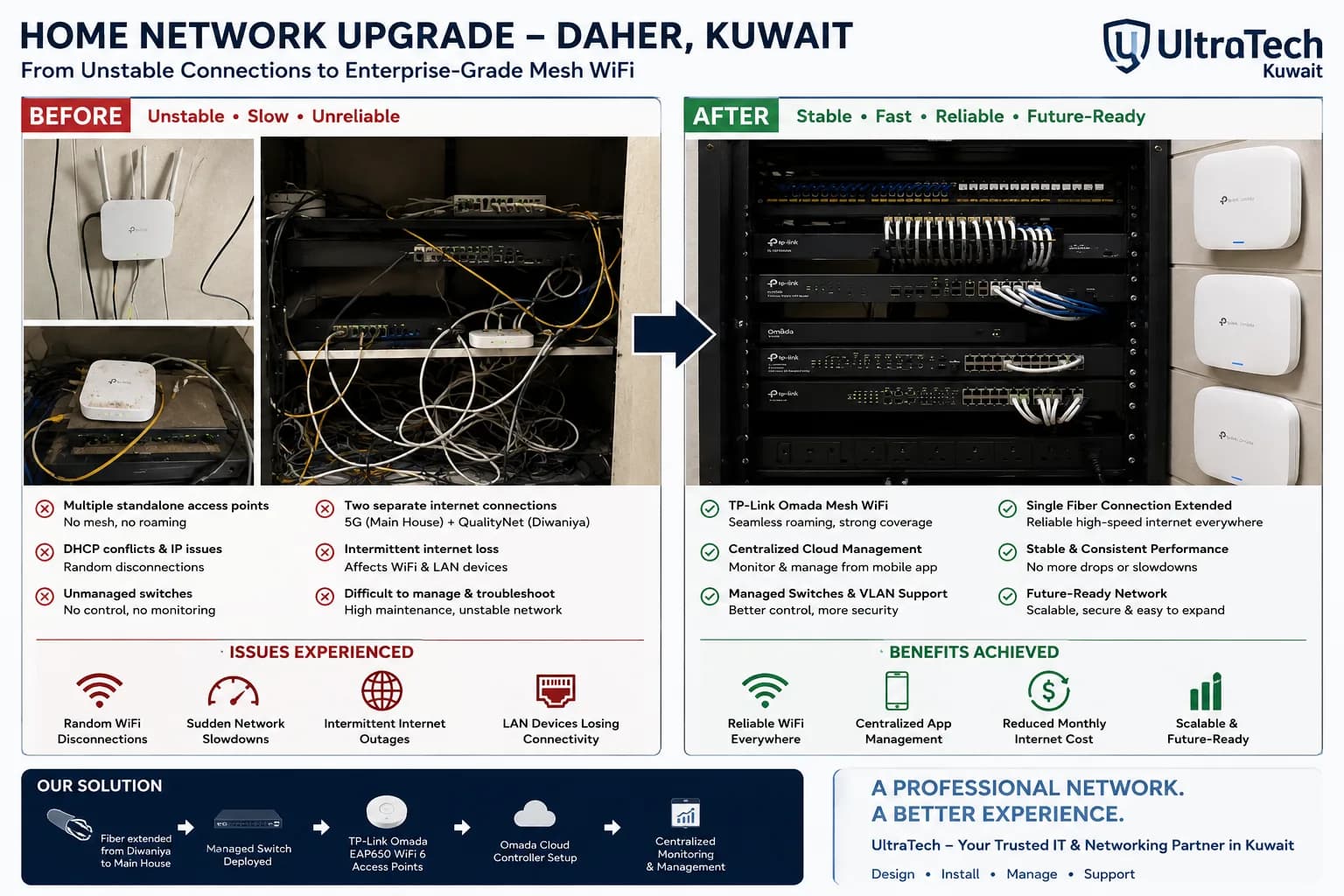
UltraTech rebuilt an unstable two-building home network in Daher, Kuwait: 7–8 standalone TP-Link TL-WA1201 access points and unmanaged switches were replaced with TP-Link Omada EAP650 AX3000 Wi-Fi 6 access points under one controller, with the QualityNet fiber line extended to both buildings over a wired backbone. The redesign eliminated DHCP conflicts and random disconnections, added seamless roaming, and cut monthly internet costs.
The Challenge
The property — a main house on a 5G internet service (500–600 Mbps down, 30–40 Mbps up) and a separate Diwaniya on a 100 Mbps QualityNet fiber line — had been unstable for an extended period: random Wi-Fi disconnections, sudden slowdowns affecting every user, and outages hitting wired devices as well as wireless.
The site survey found the cause: 7–8 standalone TP-Link TL-WA1201 access points operating independently with no controller, several unmanaged budget switches, no roaming coordination, and conditions that allowed DHCP conflicts — after a router restart or power interruption, devices received wrong IP assignments and the whole network could take a long time to recover.
The Solution
Rather than patching the fragmented setup, UltraTech redesigned the infrastructure around a centrally managed TP-Link Omada system.
The QualityNet fiber connection was extended from the Diwaniya to the main house over a dedicated wired backbone, removing day-to-day dependency on the 5G line. All standalone access points were replaced with Omada EAP650 AX3000 (Wi-Fi 6) enterprise access points managed from a single Omada controller, giving seamless roaming across both buildings, a single DHCP authority, and an infrastructure ready for future expansion.
The Results
The property now runs as one reliable network: no more random disconnections, seamless roaming as residents move between the main house and Diwaniya, stable performance for smart-home devices and streaming, and centralized monitoring of every access point and switch.
Consolidating onto the fiber line also reduced the client's monthly internet costs by removing the need to keep the 5G subscription as the primary connection.