Business Firewall & VPN EngineeringEngineer-led

Firewall · VPN · Multi-WAN · Segmentation

Business Firewall & VPN Solutions for Reliable, Secure Networks

When internet drops, VPNs fail, or security rules grow out of control, operations suffer. UltraTech Kuwait designs, deploys, migrates, and supports firewall infrastructure—including pfSense and OPNsense—for offices, branches, warehouses, and hybrid teams across Kuwait.

  • Firewall assessment & architecture
  • VPN for remote & branch teams
  • Dual-ISP failover & uptime
  • Migration from legacy firewalls
  • Segmentation for CCTV, Wi‑Fi & IoT
  • Performance tuning & rule cleanup
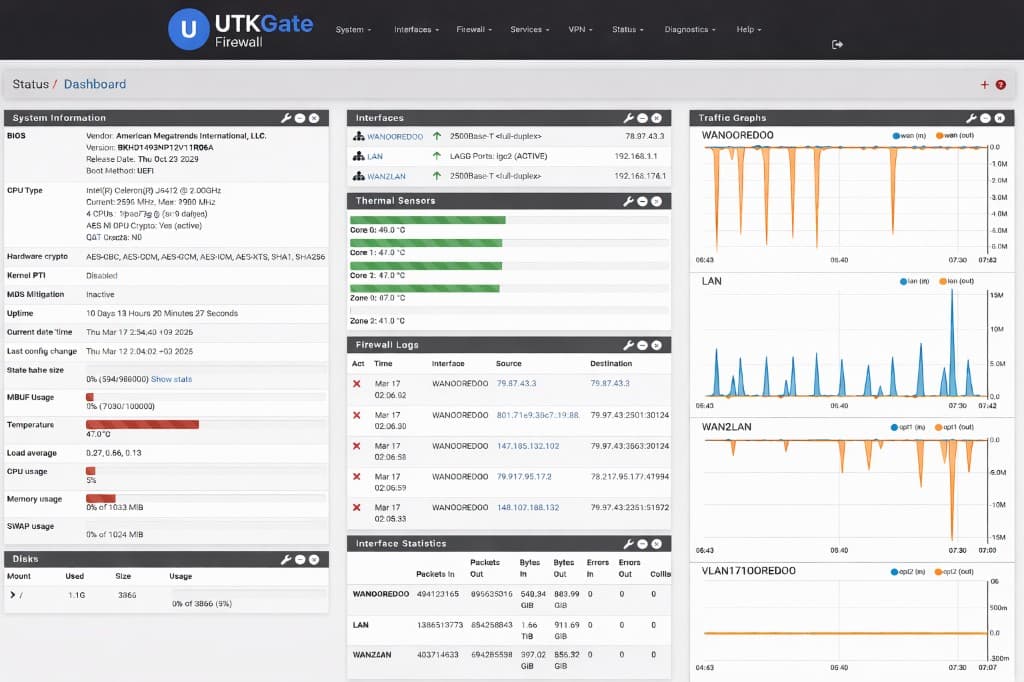
Business firewall policy dashboard for Kuwait network security deployment

Firewall Problems Are Business Problems—Not Just IT Tickets

Most Kuwait businesses do not search for a software brand first. They search when payroll cannot connect, a branch loses internet, guest Wi‑Fi reaches internal servers, or a decade-old firewall cannot support modern VPN and logging requirements. Our work starts with those outcomes: stable connectivity, controlled access, visible traffic, and architectures your team can operate after handover. pfSense and OPNsense are tools we deploy when they fit your scale, budget, and compliance needs—not the headline of the engagement.

Common Firewall & VPN Problems Businesses Face

These are the issues we troubleshoot weekly in Kuwait offices, retail chains, warehouses, and industrial sites. Each block maps to how buyers actually describe outages and security gaps.

Expand each problem for symptoms, causes, risks, and remediation guidance.

What Does a Business Firewall Actually Do?

A firewall is the control point between trusted internal networks and everything else. It is not the same as the router your ISP installs—though many devices combine both roles.

Router vs firewall
A router forwards packets between networks. A firewall inspects sessions and applies policy: who may initiate connections, which ports are allowed, and how traffic is translated (NAT). In Kuwait SMB and enterprise sites, the firewall is usually where VPN terminates, VLANs are enforced, and internet failover is orchestrated.
Traffic filtering & access control
Stateful rules track connections so return traffic is permitted without opening inbound holes. Application-aware policies may restrict protocols or destinations. Role-based access is implemented by combining VPN identity, VLAN membership, and firewall rules—not by hope.
VPN & remote connectivity
Site-to-site VPN links branches to headquarters. Remote-access VPN connects laptops and phones over IPsec, OpenVPN, or WireGuard. The firewall must route, encrypt, and log these sessions while staying stable during ISP changes.
Threat visibility
Modern deployments add IDS/IPS, DNS filtering, and logging exports. On pfSense and OPNsense this often means Suricata, Zenarmor, or similar packages—enabled selectively so performance remains acceptable.

Why Businesses Need Firewall & VPN Infrastructure

Connectivity without policy is not a strategy. Firewalls translate business rules into network enforcement.

Security & data protection
Segment finance, HR, and operations; restrict inbound exposure; log access for investigations.
Remote & hybrid work
Give engineers, finance, and executives consistent access without exposing RDP to the internet.
Branch & warehouse operations
Keep inventory, CCTV, and voice systems reachable with predictable VPN and failover behavior.
Cloud & SaaS access
Route Microsoft 365, ERP, and banking portals with stable DNS and optional split tunneling.
Business continuity
Dual ISP, 5G backup, and tested failover reduce revenue loss during provider outages.
Operational reliability
Clean rule bases and monitored gateways make changes predictable instead of risky.

Firewall & Security Solutions We Provide

Services are ordered by how engagements typically run: assess, design, deploy or migrate, optimize, then support.

Firewall deployment & security architecture

Greenfield installs and network redesigns with documented policies, VLANs, and handover runbooks.

  • Requirements workshops with IT and operations stakeholders
  • Logical and physical topology design for Kuwait sites
  • Policy creation: inbound, outbound, inter-VLAN, and VPN
  • Hardware sizing or virtual appliance specification
  • Integration with existing switches, Wi‑Fi, and CCTV VLANs
Firewall migration & replacement

Move off end-of-life or over-licensed platforms with minimal downtime and verified parity.

  • Rule and NAT export analysis from legacy vendors
  • Parallel testing lab for VPN and critical applications
  • Maintenance-window cutover with rollback checklist
  • Post-migration hypercare and rule compaction
VPN solutions

Remote work and branch connectivity engineered for Kuwait ISP realities.

  • Site-to-site IPsec between offices and warehouses
  • Remote-access OpenVPN, IPsec, or WireGuard with MFA
  • Split tunnel design for SaaS and local breakout
  • Vendor and contractor access with time-bound accounts
Multi-WAN & internet redundancy

Dual ISP, LTE/5G backup, and policy routing that actually fails over when tested.

  • Gateway monitoring with DNS and ping health checks
  • Tiered failover groups and optional load sharing
  • Policy routing for banking, VoIP, and VPN stability
  • Runbooks for ISP maintenance and manual override
Network segmentation & VLAN security

Isolate guests, cameras, voice, and IoT from corporate assets.

  • Department and site VLAN design
  • Guest Wi‑Fi with captive portal or strict egress
  • CCTV and NVR networks without internet paths
  • IoT quarantine and controlled jump paths for management
IDS/IPS & security monitoring

Visibility without turning the firewall into a bottleneck.

  • Suricata or platform IDS tuning for your traffic profile
  • Log forwarding to SIEM or centralized retention
  • Alert playbooks for Kuwait support teams
  • Periodic rule and signature review

Firewall optimization & troubleshooting

Performance and stability issues are often fixable without a rip-and-replace if diagnosed methodically.

  • Latency and jitter analysis on WAN and VPN paths
  • Packet loss reproduction with controlled iperf and ping tests
  • NAT hairpin, port forward, and duplicate rule cleanup
  • VPN stability: MTU, DPD, keepalive, and gateway binding
  • CPU profiling with realistic rule sets and optional offload
  • Rule order optimization and shadowed rule removal
  • Change control documentation for audit readiness
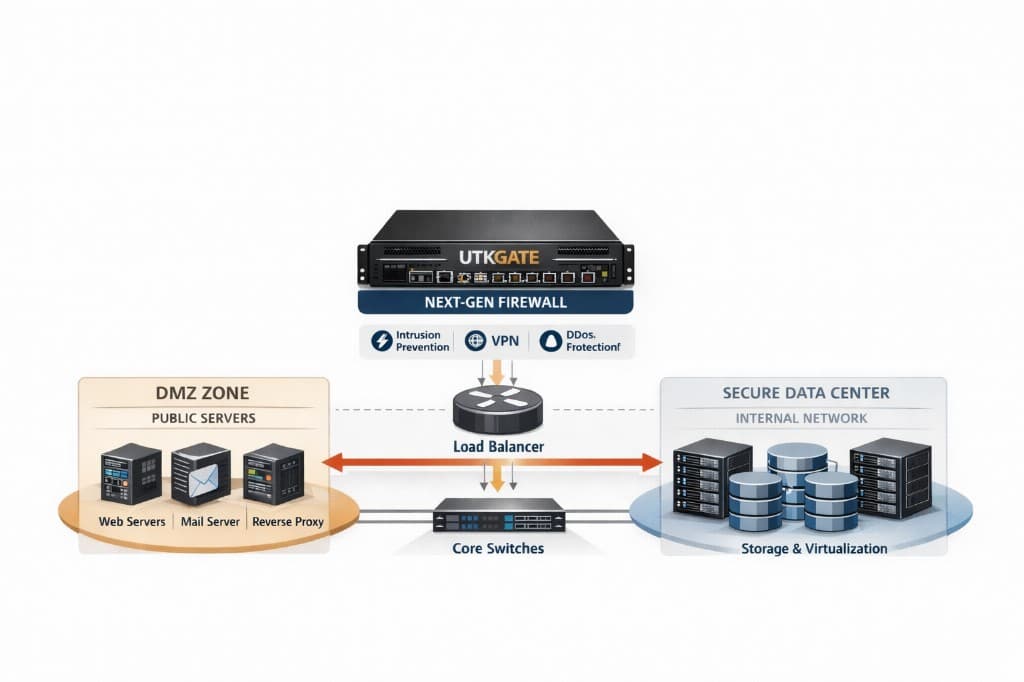
Edge firewall architecture for site-to-site VPN and dual WAN failover

Why businesses choose pfSense or OPNsense

Both are mature open-source firewall distributions built on FreeBSD with enterprise features: VPN, multi-WAN, routing, and optional IDS. They are deployed when teams want control, predictable licensing, and hardware flexibility.

What is pfSense?
pfSense began as an m0n0wall fork and is widely used as a firewall, router, and VPN concentrator. pfSense Plus (Netgate) and community builds support IPsec, OpenVPN, WireGuard, HA with CARP, and packages such as Suricata. Businesses choose it for extensive documentation, large community knowledge base, and flexible deployment on Netgate appliances or x86 hardware.
What is OPNsense?
OPNsense forked from pfSense with a focus on frequent security updates, a modern web UI, and transparent development. It includes built-in reporting, plugin architecture, Zenarmor integration, and strong defaults for WAN failover. Teams often select OPNsense when they want granular update cadence and intuitive day-two operations.
  • No per-feature licensing for core VPN and multi-WAN capabilities
  • Deploy on premises, virtualized, or cloud edge as requirements evolve
  • Full access to configuration and backups—no vendor lock-in for policies
  • Large ecosystem of packages for IDS, DNS filtering, and authentication
  • Cost efficiency versus subscription-heavy commercial NGFW at SMB scale

pfSense vs OPNsense: balanced comparison

Neither platform wins every scenario. Selection depends on your team’s skills, hardware, update policy, and integration needs.

UltraTech Kuwait deploys and supports both platforms. We recommend based on your environment—not affiliate preference.

AspectpfSenseOPNsense
User interfaceFunctional, familiar to long-time users; some advanced tasks spread across menus.Modern layout with strong search; often faster for new administrators.
Updates & securityRegular releases via Netgate; community edition cadence varies by build.Frequent security and feature releases with clear changelogs.
Plugins & ecosystemLarge package repository (Suricata, HAProxy, etc.).Plugin system with Zenarmor, reporting, and third-party integrations.
VPN supportIPsec, OpenVPN, WireGuard; strong documentation for site-to-site.Same core protocols with guided wizards and inline diagnostics.
IDS/IPSSuricata package widely used; tune carefully for CPU.Suricata plus Zenarmor option for DNS/HTTP filtering layers.
Multi-WANGateway groups and policy routing mature and well documented.Gateway failover wizard and tier model straightforward for dual ISP.
Typical use casesSites already standardized on Netgate or needing specific package parity.Teams prioritizing update cadence and UI clarity for distributed admins.
Deployment noteConfirm licensing terms for pfSense Plus vs community in commercial use.Verify hardware compatibility and backup/restore process before migration.

Real deployment scenarios (representative)

Illustrative patterns from Kuwait commercial, industrial, and multi-site environments. Names and clients are not disclosed.

Head office firewall with dual ISP

Trading company in Kuwait City with 80 staff and cloud ERP.

Challenge

Frequent fiber maintenance caused full outages; VPN to warehouse dropped during failover.

Approach

Deployed OPNsense with tiered WAN groups, DNS over each gateway, and VPN bound to monitored primary. Scheduled monthly failover test.

Outcome

Outages reduced to brief failovers; finance maintains ERP access during ISP work windows.

Warehouse segmentation

Logistics warehouse in Shuaiba with handheld scanners and office staff.

Challenge

Flat network let guest Wi‑Fi reach scanner subnet; intermittent broadcast storms.

Approach

pfSense with VLANs for corporate, handhelds, and guest; inter-zone deny by default; switch port profiles aligned.

Outcome

Stable scanning performance; guest internet without lateral access.

Retail branch VPN mesh

Retail chain with six branches and HQ in Salmiya.

Challenge

Legacy firewall VPN unstable; inventory sync delayed nightly.

Approach

Hub IPsec templates on pfSense, local internet breakout for POS SaaS, centralized logging.

Outcome

Inventory updates near real-time; branch IT uses one playbook for adds.

CCTV isolation

Industrial site with 120 cameras and on-prem NVR.

Challenge

Cameras on corporate VLAN; ransomware concern from vendor laptop.

Approach

Dedicated CCTV VLAN, no default gateway, firewall allow only NVR and viewing station; management jump host.

Outcome

Surveillance isolated; corporate AD unaffected by camera subnet incidents.

Hybrid work VPN

Engineering firm with CAD files and Microsoft 365.

Challenge

Full-tunnel VPN saturated 200 Mbps uplink; CAD users complained.

Approach

WireGuard with split tunnel for M365 and local breakout; full tunnel only to file server subnet.

Outcome

Acceptable CAD performance; security retained for internal assets.

5G failover for showroom

Showroom relying on single fiber with weekend promotions.

Challenge

LTE modem unused after previous IT left.

Approach

OPNsense tier-2 gateway on USB LTE, kill states on failover, SMS alert on WAN switch.

Outcome

Card payments continue during short fiber cuts.

Cloud-connected site-to-site

Hybrid server in Azure and on-prem ERP in Kuwait.

Challenge

Asymmetric routing broke IPsec after cloud scale-out.

Approach

Route-based IPsec with defined traffic selectors and Azure NSG alignment; monitoring on both ends.

Outcome

Stable ERP replication windows; documented rollback for cloud changes.

Legacy firewall migration

Manufacturing plant on end-of-support commercial firewall.

Challenge

Fear of downtime; 400+ undocumented rules.

Approach

Rule analytics, reduce to 120 business-aligned policies, parallel pfSense lab, Saturday cutover.

Outcome

Migration completed in one window; hypercare closed zero P1 after 72 hours.

Firewall buying & decision guides

Direct answers for common evaluation questions—structured for search and AI citation.

Which firewall does my business need?

Match the firewall to user count, throughput, VPN load, segmentation needs, and compliance—not to brand marketing.

  • Under 50 users with dual ISP and VPN: well-sized pfSense or OPNsense appliance often suffices.
  • Multi-branch with centralized policy: consider templated VPN and monitoring from day one.
  • Heavy SSL inspection or advanced NGFW features: evaluate commercial platforms or hybrid models.
  • Always size CPU for peak VPN + IDS, not headline Mbps alone.

When should a firewall be replaced?

Replace when hardware or software is unsupported, VPN/modern auth cannot be enabled, or rule chaos blocks audits.

  • Vendor end-of-support announced or security patches stopped.
  • Recurring outages not solved by ISP or rule tuning.
  • Licensing exceeds 3–5 year TCO of supported open-source or new hardware.
  • M&A or network redesign makes migration cheaper than patching legacy config.

Single ISP or dual ISP?

Any site where hourly downtime has measurable cost should plan dual paths—fiber plus LTE/5G or second fiber.

  • Single ISP is acceptable only with accepted downtime risk and offline procedures.
  • Dual ISP requires monitored failover—not just a second cable plugged in.
  • Banking and VoIP may need policy routing per provider.

VPN or SD-WAN?

VPN solves encrypted connectivity; SD-WAN adds intelligent path selection and centralized orchestration—often together at scale.

  • Few branches: IPsec hub-spoke on pfSense/OPNsense is cost-effective.
  • Many branches with multiple ISPs: SD-WAN overlays may reduce manual per-site tuning.
  • SaaS-heavy users: local breakout matters more than tunneling everything to HQ.

Hardware firewall or virtual firewall?

Hardware for site edge with defined WAN ports; virtual for cloud, lab, or HA pairs in VMware/Proxmox.

  • On-prem edge: dedicated NICs and bypass considerations favor hardware appliances.
  • Azure/AWS: virtual pfSense/OPNsense with correct licensing and HA design.
  • Avoid oversubscribing hypervisor CPU if IDS is enabled.

Open-source vs commercial firewall?

Open-source excels at VPN, multi-WAN, and routing control with lower licensing TCO; commercial NGFW adds deep integrated threat intel and support SLAs.

  • pfSense/OPNsense: strong for SMB/mid-market with in-house or MSP operations.
  • Commercial: evaluate when compliance mandates specific certifications or single-vendor support.
  • Hybrid: commercial at edge, open-source at branches is valid with clear policy ownership.

Firewall, VPN & Network Security FAQ

Detailed answers for teams evaluating firewall upgrades, VPN design, failover, and open-source platforms in Kuwait.

Plan Your Firewall Architecture With Engineers Who Deploy It Daily

Share your site diagram, ISP details, remote-user count, and current pain points. We will recommend a practical path—whether that includes pfSense, OPNsense, or a mixed environment—and quote deployment, migration, or support scope clearly.