At a glance
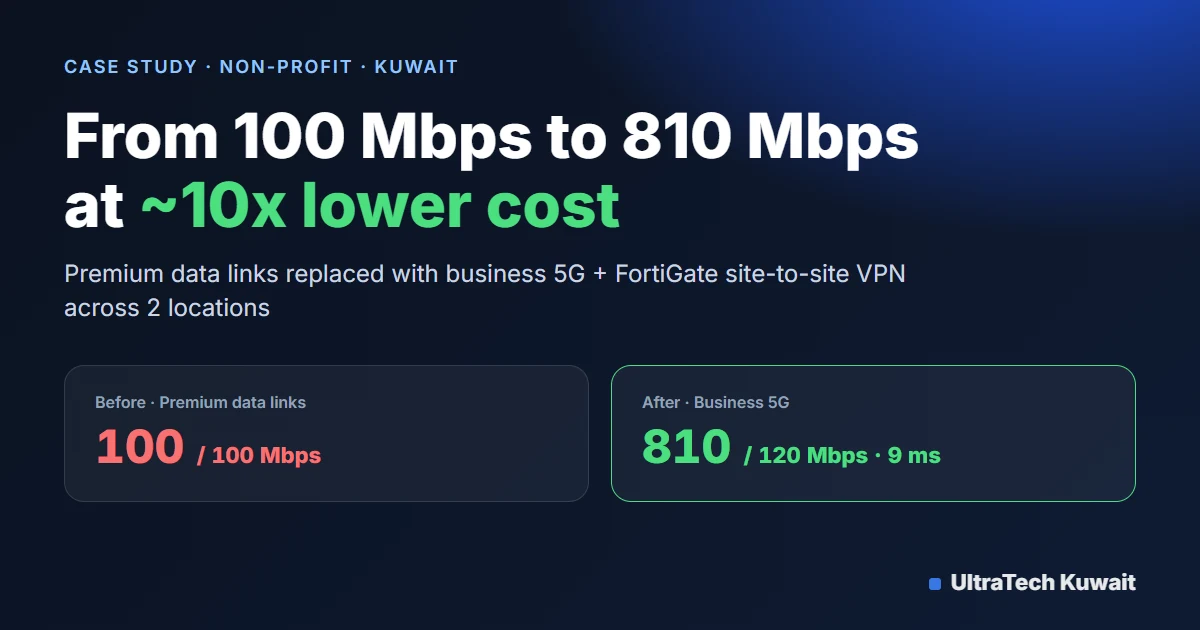
A non-profit organization in Kuwait was paying roughly 10 times more than necessary for internet that delivered only about 100 Mbps. UltraTech Kuwait audited the setup, replaced the costly premium data links with business 5G internet, and reused the organization's existing FortiGate firewalls to build site-to-site VPN tunnels between its two locations. The result: about 10x lower connectivity cost, speeds above 800 Mbps, and faster, lower-latency access between sites.
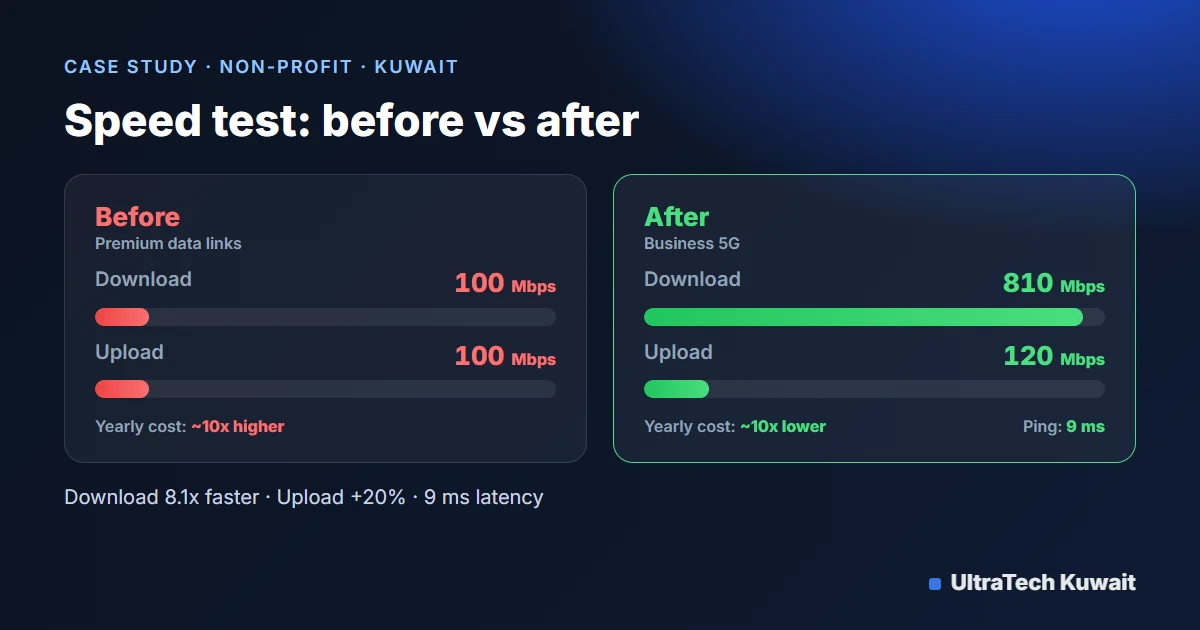
| Before | After | |
|---|---|---|
| Connectivity | Premium data links | Business 5G internet |
| Download | 100 Mbps | 810 Mbps |
| Upload | 100 Mbps | 120 Mbps |
| Ping | — | 9 ms |
| Yearly cost | ~10x higher | ~10x lower |
| Sites | Connected separately | 2 sites linked by FortiGate VPN tunnels |
| Inter-site latency | Higher | Noticeably lower |
The client
A non-profit organization operating from two locations in Kuwait. Like most non-profits, every dinar spent on overheads is a dinar not spent on its mission, so recurring IT costs matter.
The challenge: paying premium prices for a slower connection
The organization was subscribed to premium data links, a type of connectivity usually sold to enterprises that need guaranteed, dedicated circuits for specific workloads. They had been told this was the fastest possible service at the best available price, and had no reason to question it.
When UltraTech analyzed the setup, the picture was different:
- The premium links served no real purpose for their workload. Their day-to-day needs, including email, cloud applications, video calls and file sharing, did not require dedicated data circuits.
- The links were the bottleneck. The service was capped at around 100 Mbps, so the "premium" option was actually slower than what modern alternatives deliver.
- The cost was roughly 10x higher than a solution that matched their real requirements.
Our analysis
Before recommending anything, we reviewed:
- What the organization actually uses the internet for: traffic types, peak usage, and which applications are critical.
- The existing contract and link specifications: what they were paying for, and what those features were (or weren't) doing.
- The existing network equipment: the organization already owned Fortinet FortiGate firewalls, which meant the security layer did not need replacing.
- 5G coverage and signal quality at both sites, because 5G performance depends on location.
The solution: business 5G internet + FortiGate site-to-site VPN
1. Replacing premium links with business 5G
We proposed and deployed business 5G internet at the first location. Modern 5G in Kuwait routinely delivers several hundred Mbps, and at this site speed tests measured 810 Mbps download, 120 Mbps upload and 9 ms ping: more than 8x the previous 100 Mbps download, at a fraction of the cost.
2. Keeping the FortiGate firewalls in charge
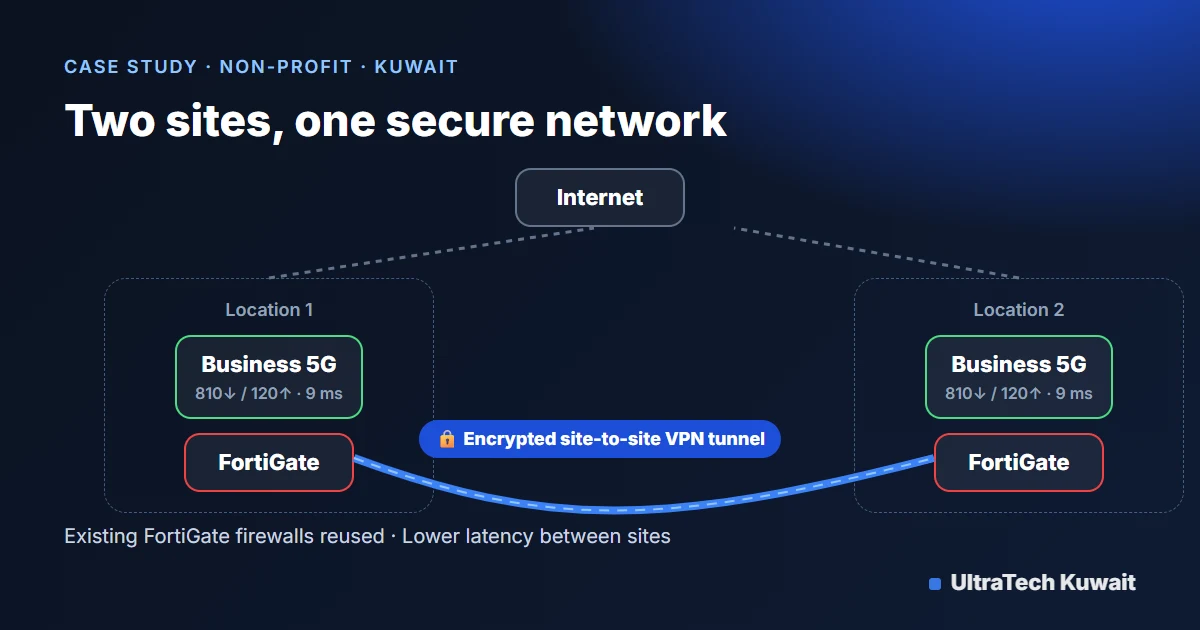
Rather than selling new hardware, we integrated the 5G connection with the organization's existing FortiGate firewalls. Security policies, filtering and monitoring stayed on the equipment they already trusted.
3. Rolling out to the second location
Once the first site showed the difference, the organization asked us to do the same at its second location.
4. Connecting both sites with VPN tunnels
We then went a step further and configured site-to-site VPN tunnels between the two FortiGate firewalls. Staff at both locations can now reach shared resources securely, as if they were on one network, with noticeably lower ping and higher throughput than before.
The results
- About 10x lower yearly connectivity cost: money the non-profit can put back into its mission.
- 810 Mbps download / 120 Mbps upload at 9 ms ping, up from 100 / 100 Mbps.
- Both locations upgraded and running on the same standard.
- Secure site-to-site connectivity over encrypted FortiGate VPN tunnels.
- Lower latency and faster access between locations.
- No firewall replacement needed: existing FortiGate investment fully reused.
Is 5G right for every business?
Not always, and an honest assessment matters more than the technology. Dedicated or premium links still make sense for some workloads, for example strict SLA requirements or specific compliance needs. 5G performance also depends on coverage at your exact site, which is why we test before we recommend. For many offices, clinics, schools and non-profits in Kuwait, though, business 5G paired with a proper firewall delivers more speed for far less money. For extra resilience, 5G can also be combined with a second line through multi-WAN load balancing and failover.
Key lesson
The most expensive internet plan is not necessarily the fastest. If your organization hasn't reviewed its connectivity contract in the last couple of years, there is a good chance you are paying for capacity or features you don't use.
Get a free connectivity review
UltraTech Kuwait will review your current internet contract, speeds and network equipment, and tell you honestly whether you can pay less and get more. Contact us to book a free assessment.
The Challenge
The organization paid roughly 10x more than necessary for premium data links that delivered only about 100 Mbps. The links offered features it did not need and were the bottleneck limiting its speed.
Our Solution
UltraTech analyzed usage and contracts, replaced the premium links with business 5G internet at both locations, integrated 5G with the existing FortiGate firewalls, and configured site-to-site VPN tunnels between the two sites.
Expert Insight
Many Kuwait organizations renew connectivity contracts for years without re-checking whether the service still matches their needs. Dedicated or premium data links are priced for guarantees, not speed, so for typical office workloads a well-deployed business 5G connection behind a proper firewall often delivers far more bandwidth for a fraction of the cost. The key is testing coverage first and keeping security on the firewall layer.
References & Sources