At a glance
A family in a three-storey villa with a basement in Abu Fatira, Kuwait had a new fiber router installed by their internet provider, and suddenly the rest of the home network stopped working. Internet only worked when connected directly to the new router. UltraTech Kuwait visited the site, found two routers handing out IP addresses at the same time, and restored stable connectivity the same visit. We then recommended a permanent upgrade: 12 Ruijie Reyee RAP2266 Wi-Fi 6 access points on one PoE core switch, managed from the Ruijie Cloud app.
| Details | |
|---|---|
| Property | 3-storey villa + basement, Abu Fatira |
| Internet | Fiber, new ISP router |
| Symptom | Internet only on the main router; rest of network cut off |
| Root cause | Old router left active: two DHCP servers on one network |
| Fixed on site | Old router removed, routers reconfigured as access points, main router reset and secured |
| Recommended | 12 × Ruijie RAP2266 + Reyee PoE core switch, cloud managed |
The problem: "The internet only works on the router"
The owner called us with a clear description: after the ISP connected a new fiber router, the internet worked on that router only, and every other part of the house network was cut off. They suspected an old switch.
With four levels of concrete, a villa like this needs more than one wireless device, so over the years several routers had been added to extend coverage. That history turned out to be the key.
What we found on site
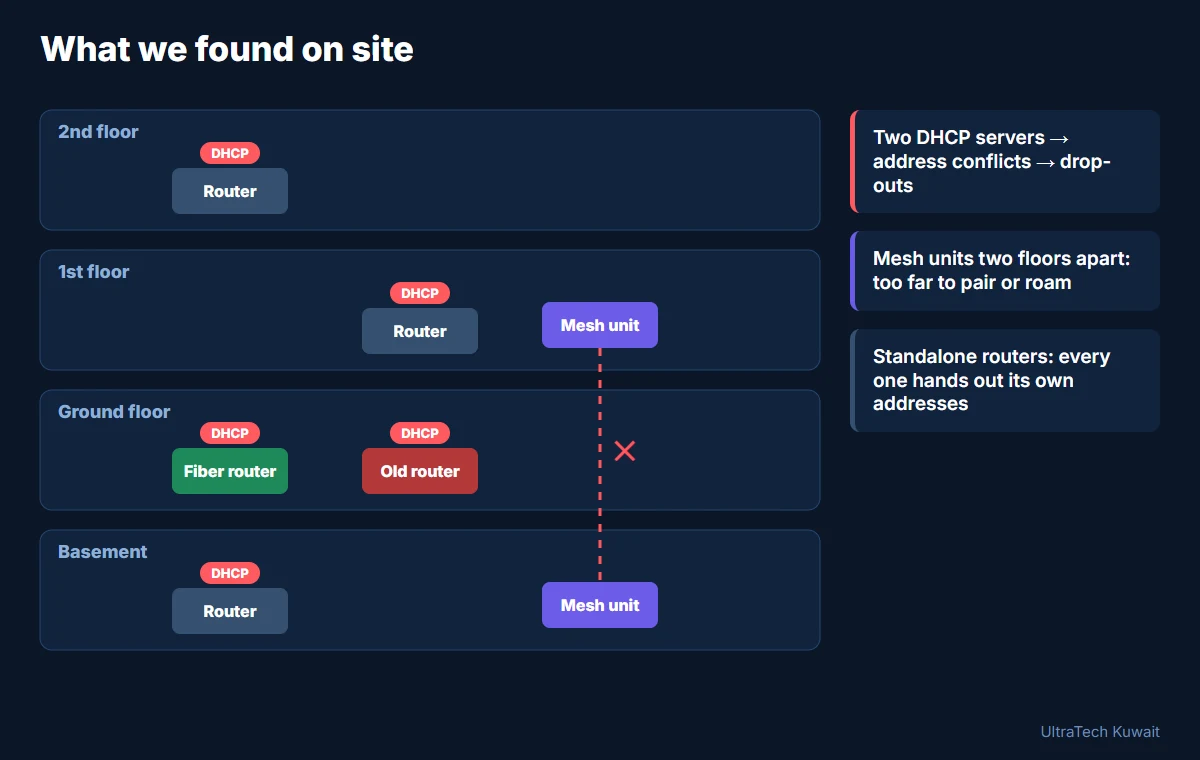
1. Two routers were both acting as DHCP servers
The ISP technician installed the new fiber router but did not disconnect the old router. Both devices were running DHCP, the service that hands out IP addresses. With two DHCP servers on one network, devices receive addresses from whichever answers first, often with the wrong gateway. The result is exactly what the family saw: some devices online, others with "connected, no internet", and random drop-outs.
2. Two mesh units installed far too far apart
The technician had also installed two mesh routers: one in the basement and one on the first floor. Mesh is designed so that nodes sit within good range of each other and hand your phone from one to the next as you move around. Separated by a full floor of concrete, the two units could barely talk to each other, so they added cost without delivering real coverage or roaming.
3. Every other router was working as a separate network
The additional routers around the villa were each running in router mode, with their own DHCP and their own network. Even when everything was "working", nothing was connected into one system and there was no roaming: walking between floors meant dropping and rejoining networks.
4. The main router password had been changed
The main router's admin password had been changed during installation without the owner's knowledge, so the family had no control over their own equipment.
What we fixed on the same visit
- Removed the old router so there was a single gateway to the fiber connection.
- Reconfigured the other routers as access points (bridge/AP mode) so they stopped handing out addresses. One DHCP server now serves the whole house.
- Reset and reconfigured the main fiber router, handing the admin credentials back to the owner and stabilising the fiber internet.
Our recommendation: one centrally managed Wi-Fi system
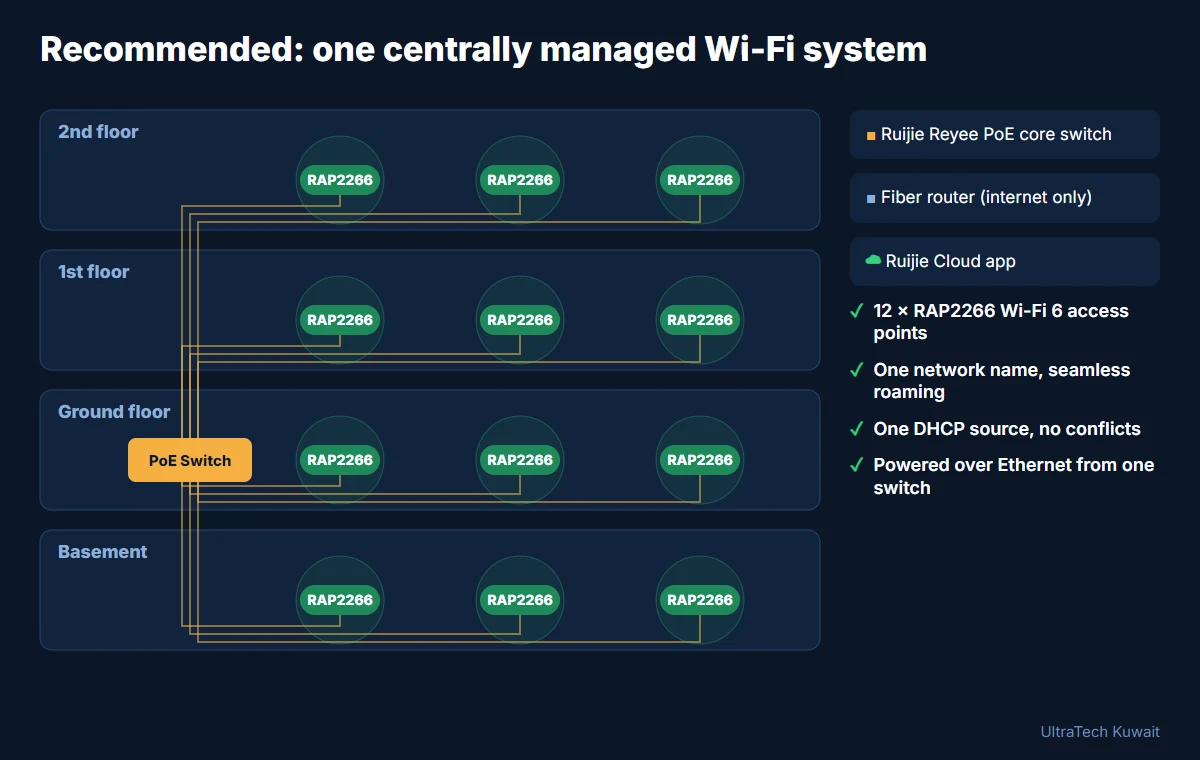
Rather than keep patching a mix of consumer routers and mesh units, we recommended replacing them all with a single, properly designed system:
- 12 × Ruijie Reyee RG-RAP2266 Wi-Fi 6 ceiling access points, placed across all four levels so every room has a strong signal.
- One Ruijie Reyee PoE core switch that powers every access point over its network cable, so there are no power adapters and one place where the network is controlled.
- The fiber router used only for internet, with one DHCP source and no conflicts.
- One Wi-Fi name throughout the house, with seamless roaming as you move between floors.
- Ruijie Cloud app management, so the network can be monitored and supported remotely.
Lessons for any villa owner in Kuwait
- Only one device should hand out addresses. When a new router goes in, the old one must be removed or switched to access-point mode.
- Mesh is not magic. Nodes placed floors apart through concrete cannot roam or relay well.
- More routers do not equal better Wi-Fi. Several standalone routers create several networks, not one.
- Keep control of your admin passwords. Ask any installer to hand them over.
- Big villas need a designed system. Cabled access points on a PoE switch are the reliable answer for multi-floor homes.
The Challenge
After the ISP installed a new fiber router, internet worked only on that router and the rest of the villa network was cut off. The old router was still active, two mesh units were installed floors apart, and the main router password had been changed without the owner knowing.
Our Solution
UltraTech removed the old router, reconfigured the remaining routers as access points so only one device runs DHCP, and reset and secured the main fiber router. For a permanent fix we recommended 12 Ruijie Reyee RAP2266 Wi-Fi 6 access points on a Reyee PoE core switch with Ruijie Cloud management.
Expert Insight
The most common home-network fault we see after an ISP visit is a second DHCP server: the new router goes in and the old one is never removed. In a concrete villa, adding more consumer routers or mesh units rarely helps; a small number of cabled Wi-Fi 6 access points on one PoE switch gives full coverage and true roaming.
References & Sources